Interview
_______________________________________________
Excerpt from an interview conducted via e-mail
in April 2024, as preparation for the exhibition
Vicissitude (April 19–June 7, 2024), with curator
Tye Dandridge-Evancio at the Estevan Art Gallery
and Museum.
_______________________________________________
What is this exhibition about?
Vicissitude is about change, negative change—the changes brought on by climate change and the human misuse of our planet—focusing on the four elements: earth, air (wind), fire, and water (including ice).
The decision to create an artwork that sits on the floor rather than on the wall is very interesting and evocative. Can you tell me a little about why you chose to display it this way?
We wanted to create a strong experience—an immersive experience—that you couldn’t distance yourself from. An immersive experience is about feeling surrounded, being inside the art piece. This generated the idea of creating a floor piece; as you have to walk on it, you cannot avoid being inside the art.
Another advantage of the floor piece is that when you are allowed to interact with an art piece in another way than you normally do—by walking on it, using it, wearing it down—you look at it in another way. This means that the art piece is taken down from the pedestal and really becomes approachable. As a spectator, you understand that this art piece is about experiencing, not about buying it to decorate your home or to collect it.
Having an artwork you can walk on also means that the spectator become careful and slow down. They thread gently as it is an art piece, and they understand that they have to approach this art piece in another way—which might create a more open state of mind and generate thoughtfulness.
What drew the two of you to work together on this exhibition?
We first became aware of each other via Instagram—both Monique and I are working with printmaking, pushing the borders of the techniques in different ways, and are interested in creating an experience. This started an interest in each other’s work… We came to realise that we were working in parallel on some motifs, like the cracking soil during drought and butterflies (though mine were dead, in contrast to Monique’s swarming butterflies), and understood we both dealt with concerns for climate change in our art. So we decided we should make a project together and that we should do screen printing.
Both of your art practices address concepts of art as an experience. What kind of experience does Vicissitude present viewers with?
The size of Vicissitude and the fact that you have to walk on the art piece makes the experience immersive—as a spectator, you step onto, and into, the art piece and become part of it somehow. Walking on Vicissitude makes you a participant who can control the experience and explore the art piece by moving around and stopping here and there, looking at certain details, drawing your own conclusions about what you see.
You can also see it as the experience of walking on this earth—and in person, experience the drought, wildfire, storm, dead insects, and plastic garbage.
Please describe the process for creating your works. Was the installation planned in advance or created intuitively?
In some ways, you could say that Vicissitude was meticulously planned, and in some ways, you could say it was created intuitively. We decided that the framework and the concept for the artwork was climate change, focusing on the four elements—and that we wanted to create a floor piece that was adaptable. This part was thoroughly planned; how the elements should be divided on the panels, how the different panels should be made in transitions and in size in order for the floor piece to be adaptable to different exhibition spaces, and to make it possible to use in different ways.
While planning and discussing the concept of the four elements as a way to treat the subject of climate change—we also, separately, in our respective countries, prepared images that would be used for the printing process.
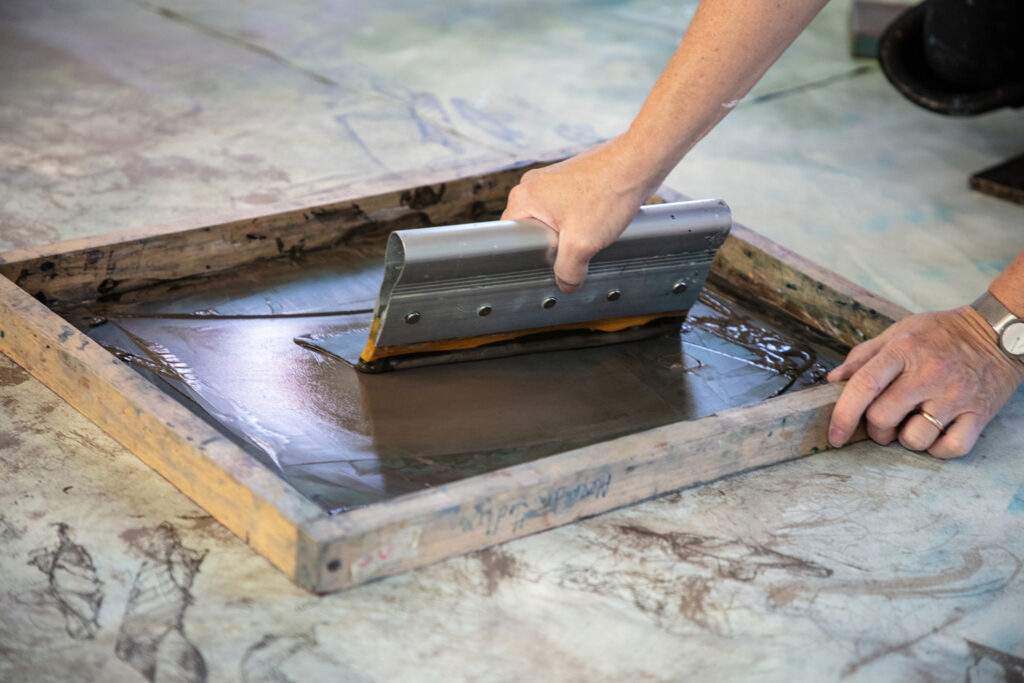
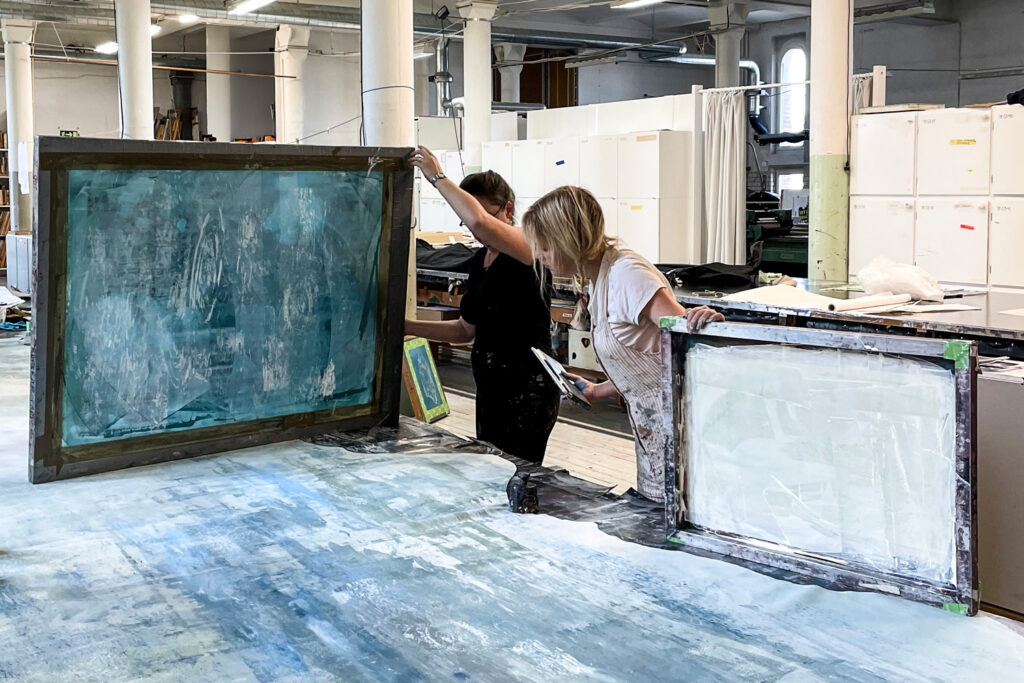
When the making was about to start—and we had finally met in person in Gothenburg—we discussed the emotions, the motion in the composition, the colour scheme in the specific section we were to work on—and then got going. We had both individual screen printing frames with our own motifs and used these to “paint the picture”, improvising within the framework we had decided on. The work flowed, but in waves—working intuitively—stopping, looking, talking—then back to printing. We were like free dancers moving around on top of our ongoing work—sometimes dancing together, sometimes separately, and in a constant flux. The work grew under us while working on the separate sections, not seeing the whole other than in our minds. Then we had to take a step back—put it together; was this transition working? Wasn’t that part missing something? And then go back to printing.
As opposed to one long piece, Vicissitude is made up of several long-segmented strips layered together. Are the panels arranged the same way every time, or does the layout change from show to show? How does this relate to the overarching themes of the exhibit?
The panels were thoroughly planned to be usable in several different ways depending on the site-specific possibilities of different exhibition spaces. Smaller exhibition spaces might not be able to show the whole floor piece, and this was part of the calculation. The art piece still works—it’s changeable and can, in some shows, present more of a certain aspect of climate change and less of something else.